Lining builds a new pipe inside the old one, so it needs a host that holds its shape and it trims the bore slightly. Bursting destroys the host and pulls in a new pipe, so it handles broken or undersized pipe and can go bigger. Lining usually needs fewer excavations and copes better with many connections; bursting wins when the old pipe is structurally gone or more capacity is needed.
- The first question is structural: if the old pipe cannot hold a liner's shape, lining is off the table and bursting or digging remain.
- Bursting can increase pipe size; every lining method reduces it slightly.
- Lining can often be done from one access point, while bursting needs pits at both ends and at each connection.
- Industry guidance favours bursting over lining when there are few connections, the host is badly deteriorated and more capacity is wanted.
- Planning ranges for a 15 to 25 m lateral overlap: about $9,000 to $28,000 for full-length relining and $10,000 to $30,000 for bursting.
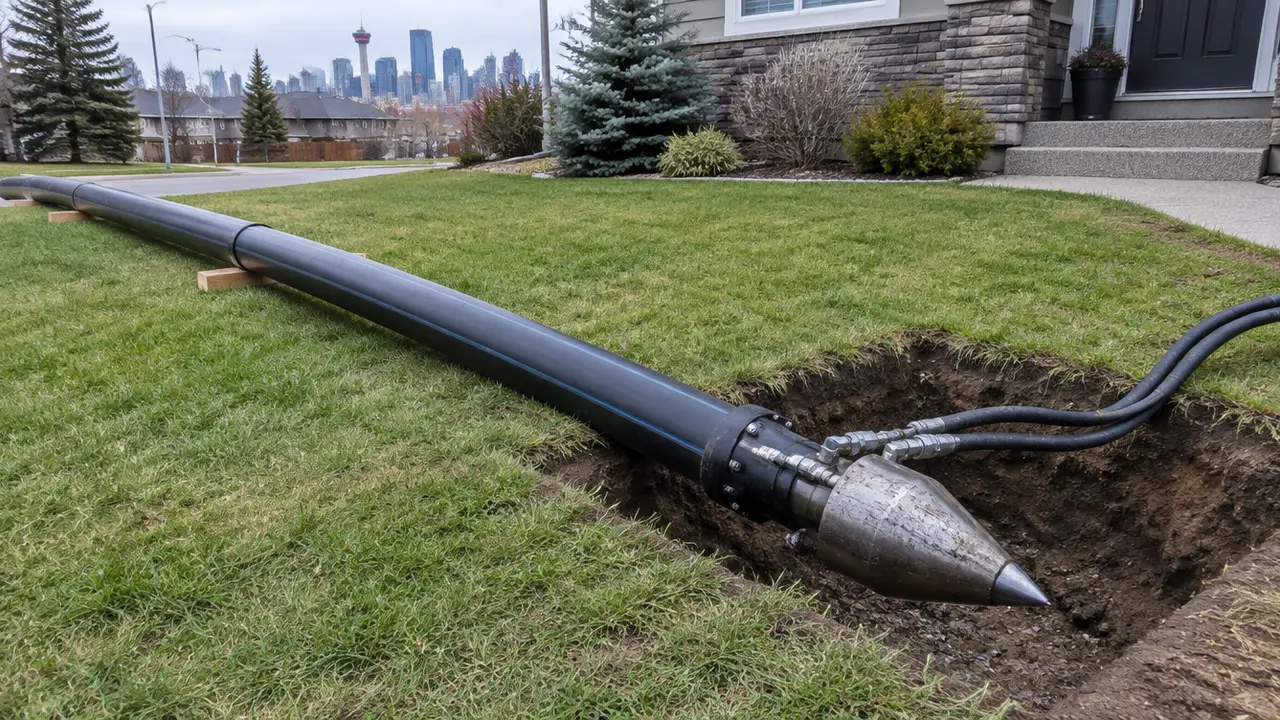
01 /What is the core difference between bursting and lining?
Lining rehabilitates a pipe; bursting replaces it. A cured-in-place pipe (CIPP) liner is a resin-saturated tube inverted or pulled into the old pipe and hardened there, forming a new pipe that relies on the host for its shape and support during installation. Bursting uses the host only as a guide path and leaves a completely new pipe that does not depend on the old one at all.
The Plastics Pipe Institute's handbook puts the trade in two sentences: the main advantage of lining methods over bursting is the need for small or no access excavation, while bursting's unique advantage is the ability to upsize. Everything else follows from those two facts.
02 /When is bursting the better choice than lining?
The PPI handbook says bursting is most cost-advantageous compared with lining when there are few lateral connections to reconnect within a section, the old pipe is structurally deteriorated, and additional capacity is needed. The EPA's fact sheet adds that bursting typically gives the largest gain in hydraulic capacity of any trenchless method, because lining reduces the existing inside diameter.
| What the camera shows | Lining | Bursting |
|---|---|---|
| Round pipe with cracks, root-packed joints, minor infiltration | Strong fit | Works, but replaces more than needed |
| Missing pieces, broken sections, pipe out of round | Often unsuitable; liner may not bridge | Strong fit if a cable can pass |
| Collapse the camera cannot pass | Needs a dig first | Needs a pit at the collapse first |
| Pipe too small for the load | Makes it slightly smaller | Can go up one or more sizes |
| Many branch connections along the run | Reinstated from inside | One excavation per connection |
| Line under a slab or a building | Often feasible from inside | Hard: pits and heave near the slab |
| Sag holding water | Keeps the sag | Usually keeps the sag |
| Offset joints | Liner may wrinkle or fold at the step | Head generally breaks through, but offsets can snag |
That last row is why the Pipe Bursting Fit Check adds a point for offset joints: they can catch the head. Liners have their own trouble with large offsets, so neither method is a clean answer there.
03 /When is lining the better choice than bursting?
Lining is usually better when the host is still structurally sound, the size is adequate, and digging is expensive or impossible. Typical examples are a building drain under a finished basement slab, a line with several branch connections, or a run under a structure where outward soil movement is unacceptable.
- Access. A liner can often be installed from a cleanout or a single small pit; bursting always needs two pits per run.
- Connections. Lining reinstates branches from inside with a robotic cutter; bursting needs an excavation at each one.
- Ground movement. A liner pushes nothing into the soil; bursting always displaces some.
- Under structures. Bursting a shallow pipe under a slab risks lifting it; lining avoids that.
Sister site SewerReplacement.ca covers lining itself in depth. This page stays on bursting's side of the comparison.
04 /What about sliplining and sectional liners?
Sliplining pulls or pushes a smaller new pipe into the old one and usually fills the gap between them with grout. It needs no special curing, but the new pipe must fit inside the old one, so the bore shrinks noticeably. It suits larger pipes with capacity to spare. Bursting, by contrast, pushes the old pipe out of the way so the new pipe can be the same size or bigger.
Sectional or point liners repair one defect at a time. If the camera shows one cracked joint on an otherwise sound line, a sectional liner is far cheaper than either full relining or bursting. Bursting is not a spot repair; it replaces the whole run between two pits.
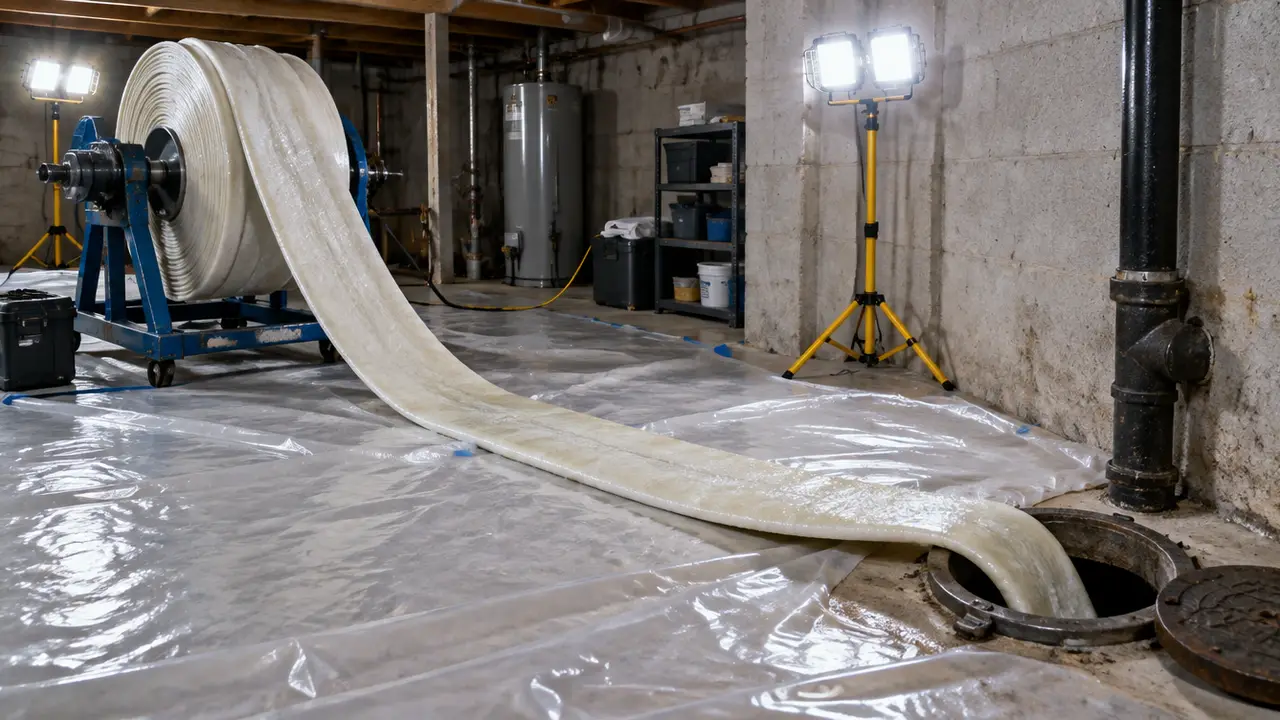
05 /How do bursting and lining compare on cost?
On a typical house lateral, the ranges overlap so much that the site decides. Using the 2026 CAD planning ranges published across the HAUSE Sewer network, full-length CIPP relining of a 15 to 25 m lateral typically quotes about $9,000 to $28,000, and pipe bursting of the same length about $10,000 to $30,000. A single sectional liner for one defect is far less, about $2,500 to $6,500 for the first section.
| Method | Typical quoted range | What moves it |
|---|---|---|
| Pipe bursting | $10,000–$30,000 | Number and depth of pits, surface over each pit, upsizing |
| Full-length CIPP relining | $9,000–$28,000 | Length, diameter, number of branch reinstatements, cleaning needed first |
| Sectional liner, first defect | $2,500–$6,500 | One defect; each extra section on the same visit costs less |
Bursting tends to come out ahead when the host is too broken to line without digs anyway, or when upsizing is needed. Lining tends to win when there are several connections or when pits would land in expensive concrete. The detailed bursting breakdown is on pipe bursting cost; network-wide price comparisons live on SewerQuotes.com.
06 /Can bursting and lining be combined on one line?
Yes, and on older houses it is often the most sensible plan. A typical split is to line the building drain under the basement slab from inside, where pits and heave are unwelcome, and to burst the lateral outside from a pit beside the foundation to the property line, where the clay is broken and the yard is open. The two meet at the launch pit, where a transition coupling joins the lined section to the new polyethylene.
- Under the house: lining avoids breaking the floor and pushes no soil against the footing.
- Outside the foundation: bursting replaces pipe too broken to line and can upsize if needed.
- At the city side: whichever method the municipality allows for its portion, if it is being replaced at all.
A combined plan means two specialties and sometimes two crews, so ask who is responsible for the joint between the two sections and who warrants it. It also means two sets of video: one of the lined section and one of the burst section, with the transition clearly visible.
07 /How do I decide between them for my line?
- Get a recorded camera run of the whole line and a written defect list with distances.
- Mark every branch connection and every bend on a sketch of the lot.
- Decide whether size matters: added fixtures, a suite, a municipal minimum.
- Note what sits over each likely pit location.
- Ask at least one lining installer and one bursting installer to price the same footage.
- Compare the number of excavations, the finished bore, and what each warranty covers.
Run the Fit Check for a first read on bursting, and see pipe bursting vs open cut for the third option. When you have footage, request quotes and ask each installer why their method fits your defects.
FAQQuestions people ask
Which lasts longer, a burst HDPE pipe or a CIPP liner?
Neither has a verified lifespan for your specific line. Both are marketed on multi-decade industry estimates; installation quality, connections and grade decide real life.
Can a pipe be lined after it has been burst?
It rarely needs to be, since the new pipe is continuous HDPE. If a defect appears later, spot repairs or lining are possible in principle.
Why would a contractor recommend bursting over lining?
Common reasons are a structurally failed host, missing pipe sections, a need to upsize, or a liner that would not seal to badly broken pipe.
Is pipe bursting more disruptive than lining?
Usually somewhat, because it needs pits at both ends and at each connection. On a straight run with no branches the difference can be small.
Does lining or bursting handle roots better?
Both remove joints from the equation along the renewed length. Burst HDPE is fused and jointless; a liner covers the old joints. The ends and connections remain the weak points.
NETWORKGo deeper across the HAUSE Sewer network
Permanent fixes for roots in sewer lines
Permanent fixes for roots in sewer lines: CIPP lining, sectional point repairs, pipe bursting and open-cut replacement compared by cost, lifespan and fit.
SewerQuotes.comSewer pipe lining cost: what a CIPP liner should cost in Canada
Sewer pipe lining cost in Canada (2026): CIPP liner ranges in CAD for full laterals and single sections, the line items, cost drivers and quality checks.
SewerJetting.caJetting before trenchless lining: why the prep cleaning decides the result
Why jetting before trenchless lining matters: root removal, descaling cast iron, cleaning to a bare wall, camera checks and what rushed CIPP prep causes.