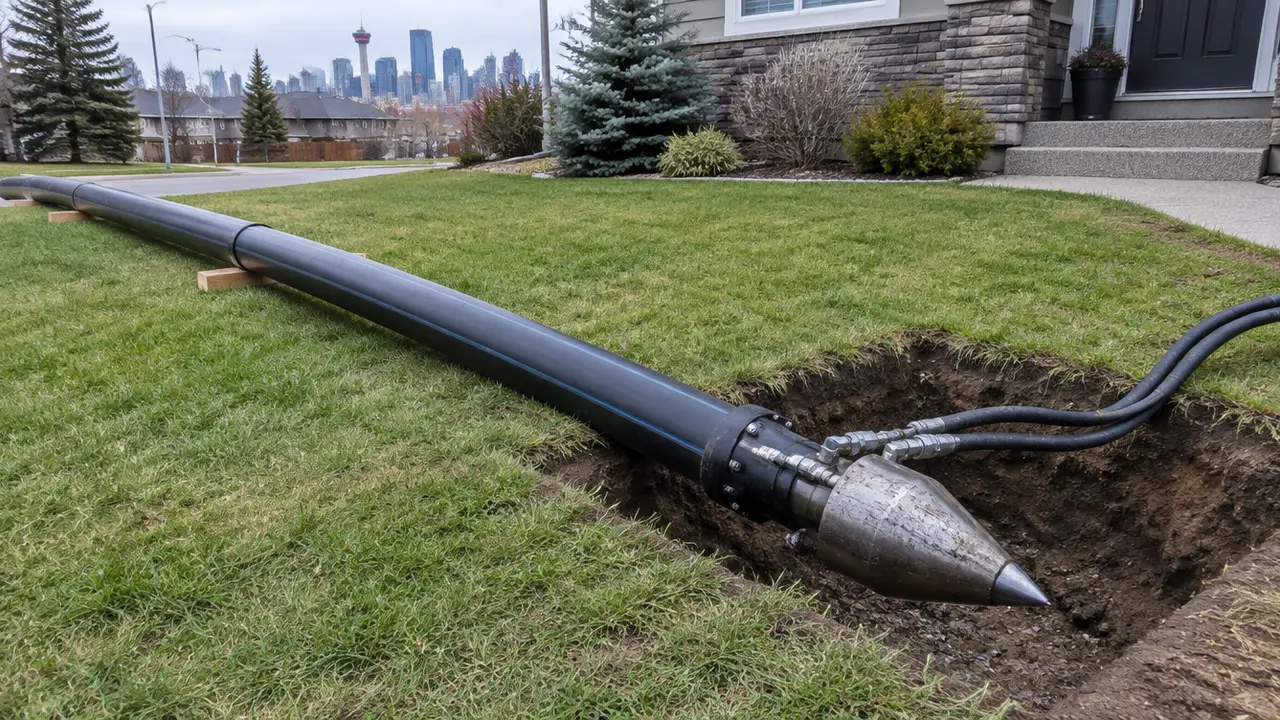
Pipe bursting is a trenchless replacement method. A cone-shaped head is pulled through the old pipe from one pit to another; it cracks the pipe, shoves the fragments outward into the soil and drags a new continuous pipe, usually fused HDPE, into the space it opens. The old line is destroyed rather than reused, and the new pipe can be the same size or larger.
- Bursting replaces the pipe: the old line is broken apart in the ground and a brand-new pipe takes its place along the same route.
- Energy reaches the head by steady pulling (static), by a compressed-air hammer (pneumatic), or by a head that expands hydraulically.
- The method needs a pit at each end of every run plus an excavation wherever a branch or service joins the line.
- It works on most brittle host pipe, can go up a size, and does not care how badly the old pipe is broken as long as a cable or rod can be threaded through.
- It follows the old alignment and grade, so a sag in the old pipe is a design problem to solve before the burst, not after.
01 /What is pipe bursting in plain terms?
Pipe bursting is a way to replace a buried pipe without digging a trench along its length. The existing pipe is used only as a guide path: a hardened, cone-shaped bursting head travels through it, breaks it into pieces, forces those pieces into the surrounding ground, and pulls the replacement pipe in behind it in the same pass. When the head arrives at the far pit, the new pipe is already in place end to end.
The US Environmental Protection Agency, in its 2006 fact sheet on the method, describes it as a process in which the existing pipe is opened and forced outward by a bursting tool while the new pipeline follows immediately behind, filling the void the old pipe left. That single-pass idea is what separates bursting from every lining method: nothing of the old pipe is kept as part of the finished line.
You will see several names for the same family of techniques. "In-line expansion" is used for size-for-size replacement. "Pipe splitting" is the variant for tough pipe that tears rather than shatters. "Trenchless pipe replacement" is the umbrella term. On this site, "the host pipe" always means the old pipe being destroyed, and "the new pipe" or "product pipe" means what goes in.
02 /What are the parts of a bursting setup?
Every bursting job, from a 15 m house sewer to a municipal main, is built from the same handful of components. Knowing what each one does makes a contractor's site plan much easier to read.
| Component | Where it sits | What it does |
|---|---|---|
| Bursting head (expander) | Travels through the host pipe | A cone whose widest point is larger than the old pipe and slightly larger than the new pipe's outside diameter; it converts pull into outward force. |
| Pulling cable or rod string | Threaded through the host pipe from the far end | Transmits the pull. Rods take higher force; a cable runs with fewer stops. |
| Pulling unit or winch | Receiving pit | Hydraulic puller or winch braced against a thrust plate or the pit wall. |
| Air hammer or hydraulic module | Inside the head (dynamic systems only) | Adds percussive blows or expansion strokes on top of the pull. |
| New pipe string | Laid out behind the launch pit | Usually HDPE heat-fused into one length, bent gently down into the pit. |
| Launch pit | Start of the run | Long enough for the head to line up with the host pipe and for the new pipe to curve in without kinking. |
| Service or connection pits | At every branch along the run | Where laterals, services or fittings are cut off before the pull and reconnected after. |
The Plastics Pipe Institute's Handbook of Polyethylene Pipe describes the geometry precisely: the base of the cone is larger than the inside diameter of the old pipe and slightly larger than the outside diameter of the new one, which reduces friction on the new pipe and leaves room to steer it. That small oversize is exactly what the Upsizing & Displacement Calculator lets you vary.
03 /How does a bursting pull work from start to finish?
A pull is short compared with the preparation around it. On a straightforward run, the head may cross in well under an hour; the pits, locates, bypass and reconnections take the rest of the job. The sequence below is the general order the EPA and PPI documents both describe, simplified for a single run.
- Investigate the host pipe
A recorded camera run confirms material, size, route, depth, old repairs and every connection. The EPA fact sheet lists closed-circuit TV inspection as the first implementation step.
- Locate everything nearby
The provincial one-call service marks buried utilities; anything close to the route is then exposed by hand or by vacuum excavation so its real position and depth are known.
- Divert the flow
Sewage or water in the line is plugged and pumped around the work, or the building is asked not to use water for the few hours the run is open.
- Dig the pits and cut off services
Launch and receiving pits are excavated and shored. Branch connections are exposed and disconnected so the head does not drag them.
- Remove known obstructions
Steel repair clamps, ductile couplings, valves and concrete encasement are cut out ahead of time where the survey found them.
- Fuse and pull
The new pipe string is fused, attached to the head, and pulled through as the old pipe breaks ahead of it.
- Rest, test and reconnect
The new pipe is allowed to recover from any stretch, tested, camera-inspected, and joined to the existing system and to each service.
The EPA fact sheet quotes a typical bursting rate of about 30 m per hour for the pull itself. Treat that as an indication of scale, not a schedule: residential runs are short, and the pull is rarely what decides how many days the crew is on site. The sewer lateral guide walks through a typical house job day by day.
04 /Why would anyone burst a pipe instead of lining or digging it?
Bursting earns its place in three situations: the old pipe is too broken to line, the line needs to be bigger, or the ground above the middle of the run is expensive or impossible to open. It is a replacement, so the result does not depend on the condition of the host pipe at all.
- Condition does not matter much. The EPA lists as an advantage that the state of the existing pipe does not affect bursting, as long as the pulling cable can be inserted. Shattered clay that no liner could bridge is a normal bursting candidate.
- Capacity can go up. Lining shrinks the bore slightly; bursting can install the same size or one or more sizes larger. The EPA fact sheet notes it typically gives the largest capacity gain of any trenchless rehabilitation method.
- The surface stays mostly intact. Driveways, mature trees, landscaping and roads over the middle of the run are left alone; only the pits are opened and restored.
- The new pipe is continuous. Fused polyethylene has no gasketed joints for roots to find along the burst length.
It also has real costs. Pits are unavoidable, every connection is an excavation, and the head pushes soil sideways and upward. Those trade-offs are covered in pipe bursting vs lining and pipe bursting vs open cut.
05 /Where is pipe bursting used?
Bursting was developed for small cast iron gas mains and is now used on gravity sewers, sewer laterals, water mains, water services and gas lines. The EPA fact sheet puts its sweet spot at host pipes of about 100 to 600 mm inside diameter, while noting pipes from 51 mm to 1,220 mm have been replaced. For a single run, it gives about 230 m as the most appropriate maximum, with straight pulls over 300 m completed.
| Application | Typical host | What drives the design |
|---|---|---|
| House sewer lateral | Clay, cast iron, Orangeburg, older plastic | Pit locations on a small lot, foundation and gas service clearance, the city-side connection |
| Water service line | Copper, galvanized steel, lead, older polyethylene | Potable-rated pipe, curb stop and meter connections, frost depth |
| Municipal sewer main | Clay, unreinforced concrete, asbestos-cement | Manhole-to-manhole runs, bypass pumping, many service reconnections |
| Water main | Cast iron, PVC, ductile iron | Temporary water supply, pressure testing, disinfection, valve and hydrant tie-ins |
| Commercial or multi-unit building sewer | Cast iron, clay, concrete | Larger diameters, business hours, several services, traffic and access |
Pipe bursting is not a repair for a leaking pipe inside a wall or under a sink. People often search for "pipe bursting" when a frozen pipe has split in their house; that is a plumbing emergency, not this construction method.
06 /What can pipe bursting not do?
Bursting cannot put a pipe somewhere the old one did not go, and it cannot be counted on to deliver a better grade than the old pipe had. The head follows the path of least resistance, which is almost always the old pipe and its original trench backfill. That single fact explains most of its limits.
- It follows sags and bellies unless they are corrected first; see pipe bursting, sags and grade.
- It struggles in rock, dense cobble and very hard ground that will not compress to make room.
- Tough ductile iron, steel and heavily reinforced concrete need splitting tools or another method.
- Anything close to the pipe, from a gas service to a shallow slab, feels the outward push; risks and problems explains the clearances that matter.
- Each branch and each sharp bend adds a pit, so a line with many connections can end up nearly as disruptive as a trench.
If you are trying to judge whether your own line is a reasonable candidate, the Pipe Bursting Fit Check scores the host material, depth, ground, utilities, connections and camera findings in about a minute. Quick answers to the most common questions are in the FAQ, and unfamiliar terms are in the glossary. When you have camera footage and want installers to price it, request quotes.
FAQQuestions people ask
Is pipe bursting considered trenchless?
Yes. It is a trenchless replacement method because only pits at the ends of each run and at each connection are excavated, not a trench along the whole line.
What happens to the old pipe during bursting?
It is cracked into fragments that are pushed outward into the soil around the new pipe. The fragments are normally left in the ground rather than removed.
Does pipe bursting make a lot of noise or vibration?
Static systems are fairly quiet at the surface apart from the pump and excavation equipment. Pneumatic systems hammer, and the EPA notes they can produce quite noticeable ground vibration above the head.
What does the new pipe look like after bursting?
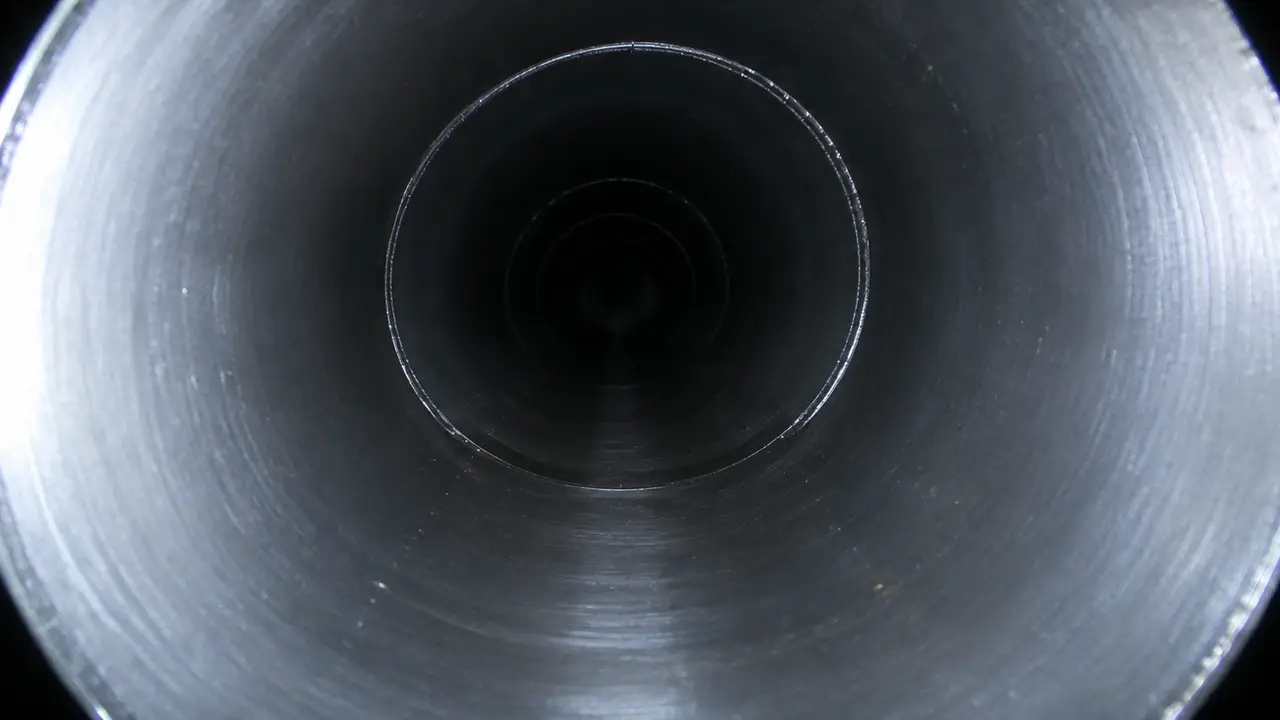
On a camera, a well-installed HDPE line looks round, smooth and black or grey, with small fusion beads at each joint and clean transitions at the ends.
Can one pull replace a whole sewer lateral?
Often, if the route is fairly straight and has no branches between the two pits. Bends the head cannot follow and each branch connection add excavations.
Who invented pipe bursting?
The PPI handbook traces it to the UK in the late 1970s, where a pneumatic head was developed to replace small cast iron gas mains before the method spread to water and sewer lines.
NETWORKGo deeper across the HAUSE Sewer network
Sewer pipe lining cost: what a CIPP liner should cost in Canada
Sewer pipe lining cost in Canada (2026): CIPP liner ranges in CAD for full laterals and single sections, the line items, cost drivers and quality checks.
SewerJetting.caWhat is hydro jetting, and how does it clean a sewer line?
What hydro jetting is: how a sewer jetter uses rear-facing jets to pull a hose up the line, scour the pipe wall and flush debris out. Plain physics.
SewerRoots.caHow to remove tree roots from a sewer line yourself, and when to stop
How to remove tree roots from a sewer line yourself: the tools that work, a step-by-step cut from the cleanout, safety rules and when to call a pro.