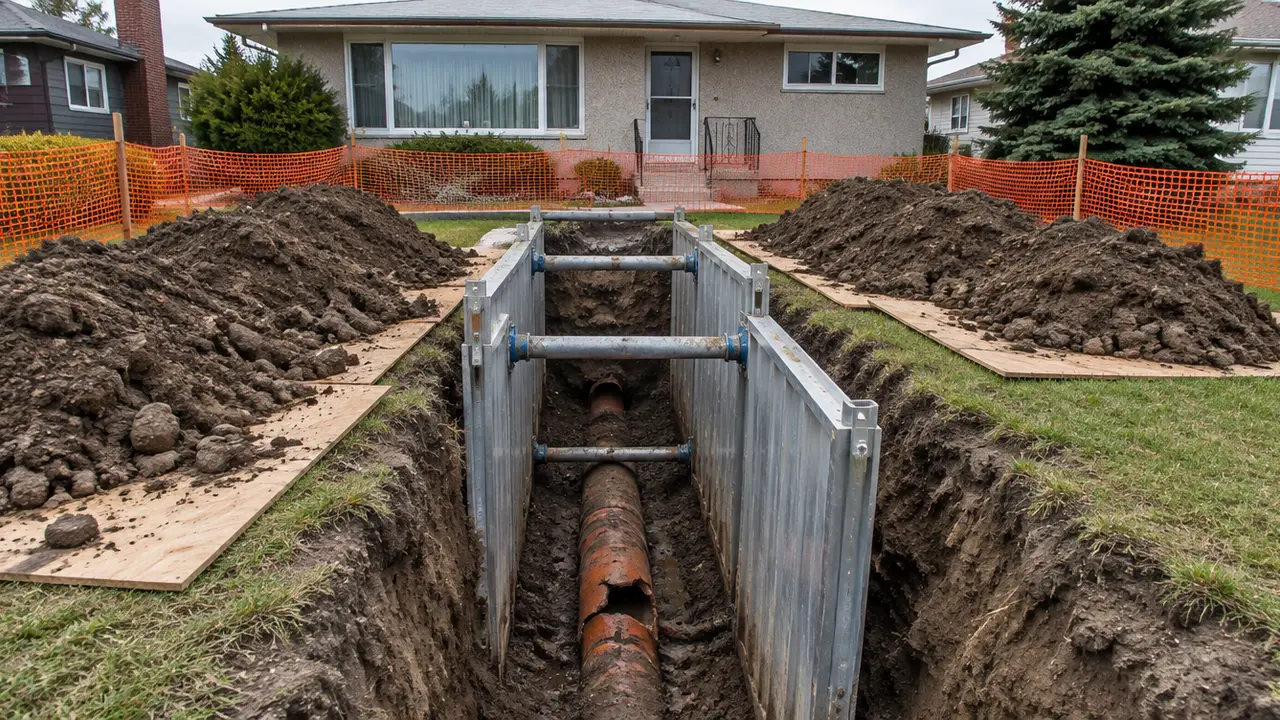
Open cut digs a trench along the whole line, removes or abandons the old pipe and lays a new one to a chosen grade and route. Bursting opens only pits and replaces the pipe along its old path. Bursting gains as the pipe gets deeper and as the surface over it gets more valuable; open cut wins on short, shallow runs under lawn and whenever grade or route must change.
- Open cut is the only way to change a line's grade and route everywhere; bursting keeps both.
- Trench cost climbs steeply with depth because of shoring, spoil and dewatering, while depth adds relatively little to a burst between two pits.
- Surface restoration often decides the winner: a lawn trench is cheap to fix, a driveway or mature trees are not.
- Directional drilling installs a pipe on a new path and is suited to new or rerouted lines rather than replacing a gravity sewer along its old grade.
- Planning ranges for a 15 to 25 m lateral are about $12,000 to $35,000 or more for open cut and $10,000 to $30,000 for bursting.
01 /How does open cut differ from pipe bursting?
Open cut, also called dig and replace or open trench, exposes the entire pipe, takes it out or leaves it, lays new pipe on prepared bedding at a set grade, backfills in compacted layers and restores the surface along the whole route. Bursting leaves the ground between the pits undisturbed and replaces the pipe in place. The EPA's fact sheet frames the difference simply: trenchless methods use the existing pipe as the path and need only small insertion pits instead of excavation along the full length.
Both end with new pipe. What differs is what you can change, what you disturb, and which conditions make each one expensive.
02 /When does bursting beat open cut?
The PPI Handbook of Polyethylene Pipe says bursting is especially cost-effective when the existing pipe is out of capacity, deep, or below the groundwater table. Its reasoning is that greater depth forces an open-cut job into more excavation, shoring and dewatering, while depth has a much smaller effect on the cost per metre of bursting. The handbook cites US municipal studies reporting average savings of about 25 percent over open cut, but those are public-sector projects from decades ago; your own quotes are the only comparison that counts.
- Deep pipe. Every extra metre of trench depth adds excavation, spoil handling and shoring. A burst adds depth only at two pits.
- Valuable surface. Driveways, patios, mature trees, retaining walls and finished landscaping over the middle of the run stay in place.
- Broken, undersized pipe. Bursting replaces and can upsize in one pass.
- Traffic and access. Lanes, sidewalks and shared driveways stay open except at the pits.
- Winter. Two small excavations are easier to thaw, protect and backfill than a long frozen trench, though frost still adds cost.
The EPA fact sheet adds indirect benefits that matter more on public projects: fewer detours, less tree removal, less noise and fewer emissions, and a smaller work zone to keep safe.
03 /When does open cut beat bursting?
Open cut wins when the line has to be different, not just new, or when the ground above it is cheap to open.
| Condition | Why digging wins |
|---|---|
| A sag or several bellies | The pipe can be re-laid on a true grade |
| The route must change | Bursting cannot leave the old path |
| Short, shallow run under lawn | Two bursting pits can cost about as much as a short trench |
| Many branch connections | Every connection is already exposed in a trench |
| Rock, cobble or very dense ground | Soil that will not compress resists bursting |
| Utilities tight against the line | A trench exposes everything; a burst pushes toward it |
| Pipe under a shallow slab | Heave risk makes bursting a poor fit |
Grade is the big one. If the camera shows a belly holding water, only excavation reliably corrects it; see sags and grade. A common compromise is to dig the sag and burst the rest.
04 /How do the costs compare?
Using the 2026 CAD planning ranges published across the HAUSE Sewer network, open-cut replacement of a 15 to 25 m residential lateral typically quotes about $12,000 to $35,000 or more, and bursting the same length about $10,000 to $30,000. Open cut runs roughly $600 to $1,000 per metre for shallow runs under soft landscaping and $1,000 to $2,000 per metre for deep work or runs under hard surfaces. Bursting is usually quoted as $550 to $1,300 per metre of new pipe plus $1,500 to $6,000 for each pit.
| Site | Open cut | Bursting | Usual winner |
|---|---|---|---|
| 15 m, 1.5 m deep, all lawn | Low end of its range | Pits plus setup, similar total | Often open cut |
| 20 m, 2.5 m deep, driveway over the middle | Upper range, heavy restoration | Two pits in lawn, mid range | Often bursting |
| 20 m with a belly near the house | Mid range, fixes grade | Needs a dig at the belly anyway | Combination |
| 25 m under mature trees | Root damage plus restoration | Pits clear of the trees | Often bursting |
The pipe bursting cost page breaks a bursting quote into its lines. For side-by-side pricing across all methods, see SewerQuotes.com.
05 /How disruptive is each method on a residential lot?
Open cut disturbs a strip the length of the line, with spoil piled beside it; bursting disturbs two or more pits plus a lay-down strip for the fused pipe that is occupied but not dug up. On a 20 m lateral that difference is the whole back yard or front walk versus a couple of holes.
| Impact | Open cut | Bursting |
|---|---|---|
| Ground excavated | The full route, often with a wide top at depth | Pits only, plus connection digs |
| Spoil on site | Large piles kept back from the edge | Small piles at each pit |
| Trees and roots | Roots crossing the trench are cut | Pits can often be placed clear of trees |
| Driveway and walks | Cut and replaced where they cross | Left alone unless a pit lands there |
| What stays in the ground | Old pipe removed or abandoned in place | Old pipe fragments compressed around the new pipe |
| Settlement later | Along the whole trench | Over the pits |
Either way, the drains are out of service for part of the work, and both need a permit and an inspection in most municipalities.
06 /Where does horizontal directional drilling fit?
Horizontal directional drilling (HDD) steers a drill head along a new underground path, reams the bore larger, and pulls a new pipe back through it. It does not need the old pipe at all. That makes it the tool for a new or rerouted line, such as a water service moved to a new entry point or a line under a road or watercourse, rather than for replacing a gravity sewer along its existing grade.
The two can combine. The EPA fact sheet and PPI handbook both describe systems in which a directional drill supplies the pull, and sometimes the air, to a bursting head, and pipe reaming, in which a drill rig grinds up a non-metallic pipe and pulls in the new one.
07 /How do I choose between bursting, digging and drilling?
- Does the grade or route need to change? If yes, dig that section, or drill a new path for a pressure line.
- Is the line deep, or is the surface above it expensive to rebuild? If yes, bursting gains ground.
- Are there many connections or tight utilities? If yes, open cut or lining gains ground.
- Is the host brittle and the ground compressible? If yes, bursting is technically comfortable.
- Get at least two methods priced from the same footage and sketch.
The Pipe Bursting Fit Check screens the bursting side in a minute, and bursting vs lining covers the other trenchless option. When you are ready, ask for quotes that price your run both ways.
FAQQuestions people ask
Is pipe bursting cheaper than digging up a sewer line?
Often when the line is deep or runs under a driveway, trees or finished landscaping. On a short, shallow lawn run, open cut is frequently the same or cheaper.
Can I burst part of the line and dig the rest?
Yes, and it is common: dig the section with a sag, a collapse or a cluster of connections, and burst the straight, deep or covered part.
Is directional drilling the same as pipe bursting?
No. Drilling makes a new bore on a new path; bursting destroys the old pipe and follows its path. Some systems combine a drill rig with a bursting head.
Does open cut last longer than bursting?
The pipe itself can be the same material either way. Open cut can set a better grade and expose every connection, which can matter more than the method.
Why does depth favour pipe bursting?
A deeper trench needs more excavation, shoring and often dewatering along its whole length. A burst adds that effort only at the pits.
NETWORKGo deeper across the HAUSE Sewer network
Sewer line replacement cost: open-cut vs trenchless, line by line
Sewer line replacement cost in Canada for 2026: open-cut, CIPP lining and pipe bursting planning ranges in CAD, per-metre math, line items and what moves price.
SewerInspector.caScope the sewer before you renovate, finish the basement or landscape
Why to get a sewer inspection before renovation, basement development, a suite or landscaping: what to check, when to book it, and how findings change plans.
SewerRoots.caSewer-safe trees and shrubs to plant near a sewer line
Sewer-safe trees and shrubs for Canadian yards: small, slow, prairie-hardy species to plant near sewer lines, what to put over the trench, and what to avoid.