Generally no. The bursting head follows the old pipe, so a belly in the host line is usually reproduced in the new one. Installers expect some small, local dips to shrink, but only a dig at the low spot, grouting under it, or a re-planned run reliably corrects a sag. A sag that holds water on the camera should be dealt with before, not after, the burst.
- A bursting head takes the path of least resistance, which is almost always the old pipe and its trench.
- Industry guidance says a line significantly out of line and grade will tend to stay that way after bursting, with only limited correction of local sags.
- Voids, soft spots, hard layers and shallow cover can push the head off line, changing grade even where the old pipe was fine.
- The Fit Check adds 2 points for a sag because it is likely to be reproduced in the new pipe.
- Fixing grade usually means an open-cut section at the low spot, with bursting on either side of it.
01 /Why does the new pipe follow the old grade?
A bursting head is pulled, not steered. The cable or rod runs through the old pipe, so the head goes where the old pipe goes, and the easiest ground to push into is the old pipe itself plus the looser trench backfill around it. Nothing in the process lifts the head out of a dip. The new pipe, attached right behind the head, lies in the same channel.
The PPI Handbook of Polyethylene Pipe lists this among bursting's specific limitations: if the old sewer line is significantly out of line and grade, the new line will also tend to be out of line and grade, although some corrections of localized sags are possible. Its design section adds that unacceptable sags need to be corrected before bursting.
02 /Can bursting ever reduce a sag?
Sometimes, a little. The PPI handbook says some reduction of sag magnitude may be expected from the bursting operation, but how much depends on the relative stiffness of the soil under the sagging section. If the pipe sank into soft ground, the head has nothing firm beneath it to ride over, and the belly stays. If a short dip sits on firm soil, the stiffer new pipe and the expander may even it out partly.
That is not something to plan on. An installer who promises that bursting will take out a visible belly is describing a hope, not a method. The safer assumption, and the one the Pipe Bursting Fit Check makes, is that the sag will be reproduced.
03 /How does a sewer develop a sag in the first place?
Most sags are settlement, not bad original work. A pipe laid on poorly compacted backfill, over a soft spot, or across the edge of an old excavation can sink over decades. A broken joint that leaks lets water carry fine soil into the pipe, hollowing out the bedding until the pipe drops into the gap. Frost, heavy vehicles over a shallow run and tree roots lifting one section can all add to it.
The cause matters for a burst. Settlement into soft ground means the soil under the dip will not support the head, so the sag stays. A void washed out beside a broken joint means the head may veer into it and create a new low spot. A section pushed up by a root or rock leaves a hump that the head may ride over, reproducing a high point with a belly behind it. When the camera crew describes a sag, ask them what they think caused it; the answer points to the right fix.
04 /What can push a bursting head off line?
Even where the old pipe was straight and on grade, ground conditions can move the head. The PPI handbook describes three tendencies: the head and new pipe deviate toward voids or lower-density soil where erosion has occurred; they move away from hard layers or rock toward softer soil; and in shallow conditions they deviate mostly upward toward the surface. It also warns that rock under the existing pipe may create a bump in the replacement.
| Condition | Likely effect | What the installer can do |
|---|---|---|
| Void or washout around a broken pipe | Head drifts into the void; new pipe may dip | Find voids on camera or by probing; fill or dig before the pull |
| Rock or cobble under the pipe | Bump or kink in the new line | Expose and remove, or relocate the run |
| Hard layer on one side | Head shifts toward the softer side | Accept small lateral shift or dig at that section |
| Shallow cover | Head climbs toward the surface; surface heaves | Reduce upsizing, use static, or open-cut the shallow part |
| Very soft or saturated soil | Settlement and new sags after the pull | Dewater, stabilize, or choose another method |
The handbook sums it up: if conditions change substantially along the burst, grade and alignment may change too, and when grade is critical these possibilities should be considered in the design.
05 /How do you tell whether a sag is serious enough to fix first?
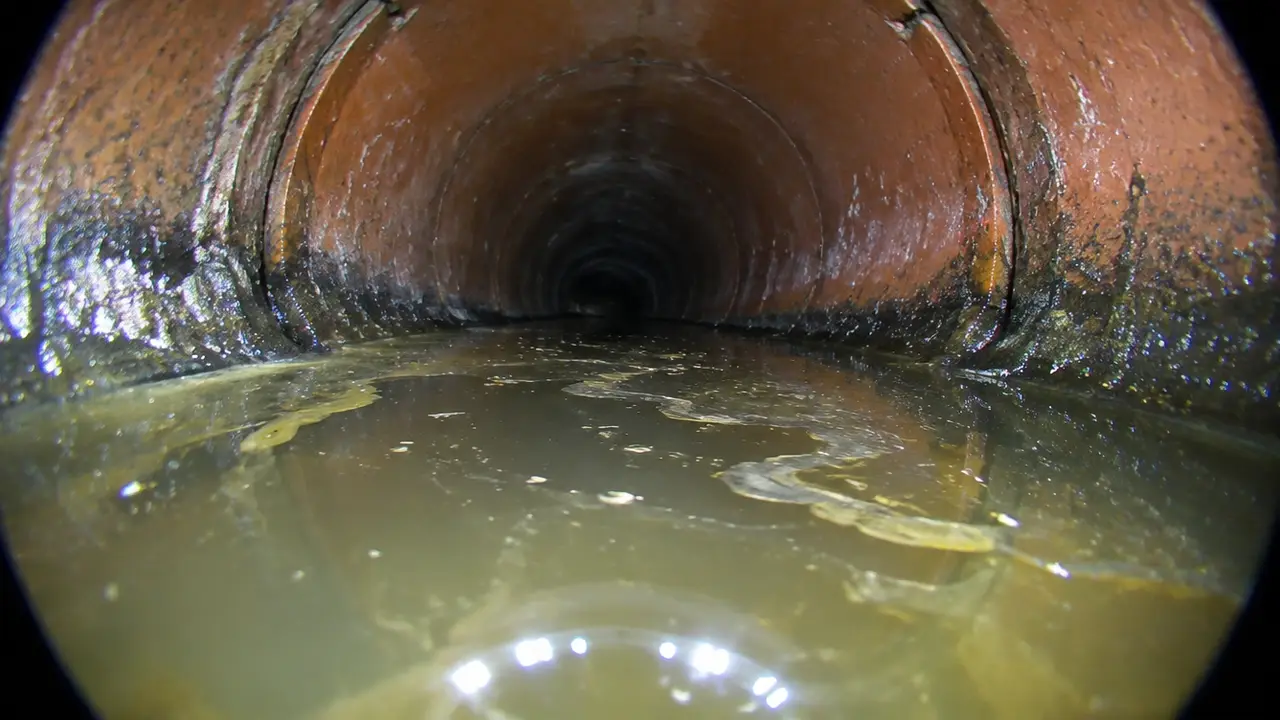
A recorded camera run shows it. Look for water that stands in the pipe when nothing is draining upstream, a camera lens that submerges, or debris lying in one stretch of an otherwise clean line. The footage counter tells you where the low spot starts and ends; a sonde locator in the camera head can mark it on the ground and give a depth.
- Length. A dip of a few tens of centimetres behaves differently from a belly several metres long.
- Depth of standing water. Ask the camera operator to estimate it relative to the pipe diameter.
- Symptoms. Recurring clogs at the same distance, or solids found at the same spot after cleaning, point to a working sag.
- Cause. A sag over a broken section with a void under it is likely to get worse, not better.
Some public specifications set limits on the finished product; the PPI handbook gives the example of a quality requirement that sags in the new line should not exceed one inch in depth, checked by post-bursting camera inspection. For a house lateral, the practical standard is simpler: the new line should drain without standing water.
06 /What are the options when the camera shows a sag?
The PPI handbook lists three ways to correct a sag before bursting: local excavation, surface grouting, or grouting from inside the pipe. On residential work, local excavation is by far the most common.
Placing a pit at the low spot is often efficient: the crew can burst toward it from one end, re-bed that section to grade, and burst away from it toward the other end. Whether that works depends on depth, what is above the sag and how long it is. For a full comparison with trenching, see pipe bursting vs open cut.
07 /Does lining or bursting handle grade better?
Neither. Cured-in-place lining forms a new pipe inside the old one and keeps every dip exactly; bursting keeps most of them. Only excavation re-lays pipe to a chosen grade. Bursting does have one small edge: because the old pipe is destroyed and a stiffer continuous pipe is pulled in, short local irregularities such as a slightly dropped joint may be smoothed. That is a side benefit, not a reason to choose it. More in pipe bursting vs lining.
If your camera report mentions a belly, include that clip when you request quotes, and ask every installer the same question: where exactly is the sag, and what will you do about it before the pull? The contractor survey guide lists what else to ask.
FAQQuestions people ask
Will pipe bursting fix a belly in my sewer line?
Usually not. The head follows the old pipe, so the belly is likely to reappear in the new line unless the low spot is dug and re-bedded first.
Why did my new burst line develop a sag?
Common causes are a void or very soft soil under the old pipe, rock creating a bump nearby, or a sag in the host that was not corrected. A camera run shows where it is.
Can grouting fix a sag before bursting?
The PPI handbook lists surface grouting and grouting from inside the pipe as options, alongside local excavation. On house laterals, excavation is the usual choice.
Can bursting change the direction of my sewer line?
No. It follows the old route. A new route needs a new bore or a trench.
Does a small dip in the pipe matter?
If water stands in it and solids collect there, it matters. If it drains fully and the line has never clogged there, many installers leave it.
NETWORKGo deeper across the HAUSE Sewer network
Pipe cleaning methods compared, method by method
Pipe cleaning methods compared: snaking, hydro jetting, descaling, chain knockers, enzymes and chemicals — what each removes, and which pipes each can harm.
SewerQuotes.comTrenchless lining vs pipe bursting: cost, fit and trade-offs
Trenchless lining vs pipe bursting cost in Canada: 2026 CIPP and bursting ranges in CAD, line items, which defects each fixes and how to choose.
SewerInspector.caCommon sewer defects, explained by what they do to the pipe
Common sewer defects explained: roots, cracks, fractures, offset and separated joints, sags, deposits, holes and collapse, with severity and usual next steps.