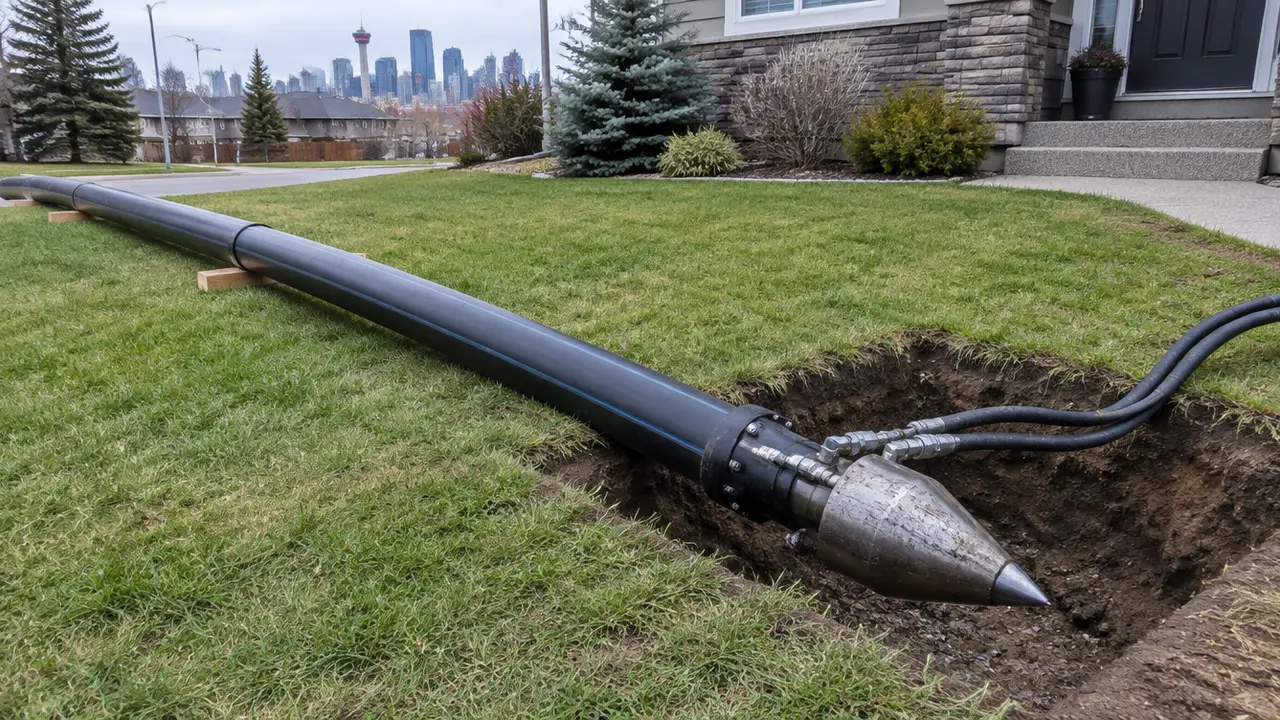
Static bursting pulls a solid cone through the old pipe with a hydraulic rod or cable puller and relies on pull alone. Pneumatic bursting adds an air hammer inside the head that strikes hundreds of times a minute while a winch keeps tension. Split bursting fits cutter wheels or blades ahead of the expander so tough pipe is slit rather than shattered. Hydraulic expansion heads open and close in place.
- The difference between systems is where the breaking energy comes from: steady pull, percussive blows, cutting blades or a head that expands.
- Static heads have no moving parts and cause less vibration, which is why they are often preferred near structures and in touchy ground.
- Pneumatic heads hammer through difficult brittle pipe and soil but can shake the ground and lift shallow surfaces.
- Ductile iron, steel and many plastics stretch instead of cracking, so they need a splitting head with blades or wheels.
- Head choice belongs to the installer, but you should know which one is planned and how it will behave near your foundation and services.
01 /What is the basic difference between static and pneumatic bursting?
Static bursting breaks the pipe with pulling force alone. Pneumatic bursting breaks it with repeated hammer blows while a winch holds the head against the pipe and drags the new pipe behind. The EPA's 2006 fact sheet sorts heads the same way: static heads have no moving internal parts, while dynamic heads add pneumatic or hydraulic force at the point where the head meets the old pipe.
Both systems end the same way, with a new pipe in the old pipe's path. What changes is how much vibration reaches the surroundings, how much pulling capacity is needed, how the crew handles a stubborn section, and what equipment has to fit in the pits.
02 /How does static bursting work?
In static bursting, a hydraulic unit in the receiving pit pulls a rod string or heavy cable that runs back through the host pipe to the head. The cone turns that horizontal pull into outward radial force, cracking the pipe and widening the cavity. The PPI handbook describes rod systems in which short steel rods, roughly 1.2 m each, are pushed through the old pipe, coupled to the head, then pulled back one at a time and removed as the head advances.
- Rods versus cable. Rods carry more force but make the pull a start-stop process as each rod is uncoupled. A cable pulls continuously, but the handbook notes its tensile capacity is more limited than a rod string.
- Low vibration. With no hammer, the ground mostly sees slow, steady expansion. That is why static systems are the usual choice close to foundations, fragile services and occupied buildings.
- Thrust matters. The puller pushes back against a thrust plate or the pit wall, so the receiving pit has to be built to take that load.
- Compact units. Small static pullers designed for house laterals fit pits sized for a residential lot, which helps on tight urban sites.
Because the handbook notes that segmented pipes such as clay or ductile iron cannot be pre-assembled into one string, static systems are also the only bursting method that can install those materials, jacking or towing each piece in behind the head.
03 /How does pneumatic bursting work?
A pneumatic head is essentially a horizontal pile hammer. Compressed air, fed through a hose that runs inside the new pipe, drives a piston that strikes the head. The PPI handbook gives a rate of 180 to 580 blows per minute and describes it as the most common bursting method. The winch cable does not provide the breaking force; it keeps the head aligned with the old pipe, keeps it pressed against the pipe wall, and pulls the new pipe along.
Each blow cracks a little more pipe and shoves fragments and soil aside. That percussion is what lets pneumatic systems punch through tough brittle pipe and compacted ground where a static pull might stall. It is also why the EPA fact sheet warns that dynamic heads can move surrounding soil, cause heave, and create quite noticeable surface vibration, and why it says static heads are preferred where pipe and soil conditions do not suit a dynamic head.
04 /What is split bursting, and which pipes need it?
Split bursting, usually called pipe splitting, is for host pipe that bends and tears instead of shattering. NASTT, as quoted in the PPI handbook, defines pipe splitting as breaking an existing pipe by longitudinal slitting while a new pipe is drawn in behind. The head carries cutter wheels or knives that slice the pipe along two or more lines, and an expander behind them spreads the opened pipe into the soil.
| Host pipe | How it behaves | Usual approach |
|---|---|---|
| Vitrified clay | Brittle, shatters cleanly | Static or pneumatic cone |
| Cast iron | Brittle but thick-walled | Static or pneumatic; heavier walls need more pull |
| Unreinforced concrete | Brittle, heavy | Static or pneumatic |
| Asbestos-cement | Brittle | Bursts; handling rules apply at the pits |
| PVC and ABS | Can stretch rather than crack | Cutting blades ahead of the cone, or confirm it fractures |
| Ductile iron and steel | Tough, does not fracture | Splitting head with wheels or blades |
| Reinforced concrete | Rebar holds the pieces together | Heads with accessories to cut reinforcing, or another method |
The PPI handbook recommends limiting polyethylene to size-on-size or a single upsize when splitting ductile iron, because the split edges of tough metal can gouge the new pipe; its research summary says clay, cast iron, concrete and asbestos-cement generally break without shards sharp enough to puncture PE. That is one of the few cases where the host material changes what new pipe is sensible, not just which head is used.
05 /What other bursting variants will I hear about?
A few other techniques share the idea of replacing a pipe along its own path. They matter mostly on municipal work, but contractors sometimes mention them on larger private jobs.
- Hydraulic expansion. The head has segments that open and close with hydraulic pressure, pushing the pipe apart in place before the head is advanced. The EPA describes one manhole-to-manhole system in which the head is jacked forward by short segmental pipe, allowing the new pipe to be clay, concrete or HDPE.
- Pipe reaming. A modified horizontal directional drilling rig pulls a reamer that grinds the old pipe up; the cuttings are flushed out in drilling fluid. The PPI handbook limits it to non-metallic pipe.
- Drill-assisted pneumatic bursting. A directional drill supplies the pull and the air to a hammer head, which can reduce pit excavation and lets the rig back out if the head sticks, at the cost of stopping to remove rods.
- Lateral bursting through bends. The EPA fact sheet describes small static heads for 100 to 150 mm house laterals that have been pulled through up to three 45-degree bends in one run.
None of these is automatically better. Each suits a range of pipe sizes, materials and site constraints, and each installer tends to specialize in one or two.
06 /How do you compare static and pneumatic for your line?
The Pipe Bursting Fit Check mirrors this logic in its method note. Ductile iron or steel returns split bursting. PVC or ABS returns a splitting head or a check that the plastic will actually fracture. Where you plan to go up two or more sizes, or where the ground is clay or silt, it notes that static bursting is often chosen where control and pulling force matter and that pneumatic suits many brittle lines. Otherwise it leaves the choice between static and pneumatic to the contractor, which is where it belongs.
Whichever head is used, the new pipe is typically fused polyethylene; see HDPE pipe and fusion. To understand how much the head pushes soil aside, run your sizes through the Upsizing & Displacement Calculator.
FAQQuestions people ask
Is static or pneumatic pipe bursting better for a house sewer?
Neither wins everywhere. Static is common on residential laterals because it is quieter and gentler near foundations; pneumatic helps on tough brittle pipe or longer pulls. Your installer's survey should justify the choice.
Why is it called static bursting if the head moves?
"Static" refers to the head, which has no moving internal parts. All the breaking force comes from the steady pull, unlike a dynamic head that hammers or expands.
Can a pneumatic bursting head crack my foundation?
Vibration and soil displacement fall off quickly with distance, but close to a footing they matter. Installers keep clearance, expose nearby services, reduce upsizing or switch to static near structures.
What is the difference between pipe splitting and pipe bursting?
Bursting shatters brittle pipe with a cone. Splitting slices tough pipe lengthwise with wheels or blades first, then spreads it with an expander.
Can plastic sewer pipe be burst with a normal cone?
Sometimes it cracks, but PVC and ABS can stretch around the cone instead. Many installers fit blades ahead of the expander or test the pipe first.
NETWORKGo deeper across the HAUSE Sewer network
Auger cutting heads, and which one to use for each clog
Auger cutting heads explained: bulb, spade, C-cutter, grabber and root saw heads, what each clears, which risk damaging old pipe, and a head selection chart.
PipeCleaning.caHow to clean outside drain pipes: downspouts, yard drains and weeping tile
How to clean outside drain pipes in Canada: downspout leaders, yard drains, weeping tile, sump lines and the sewer cleanout, plus thawing frozen lines.
SewerQuotes.comWho pays for sewer repair: buyers, sellers, landlords, tenants and condo owners
Who pays for sewer repair in Canada: buyer vs seller, landlord vs tenant, condo corporation vs unit owner, and neighbours who share one sewer lateral.