The main risks of pipe bursting come from pushing soil outward: surface heave over shallow lines, vibration from pneumatic heads, and damage to gas, water or power lines close to the route. Other problems include heads stalling on repairs or rock, groundwater flowing into pits, fragments entering manholes, and the new pipe shrinking back at connections. Most are foreseeable with a camera survey, locates and exposed crossings.
- Ground displacement is localized and fades quickly with distance, but shallow pipe, big upsizes and weak nearby utilities make it critical.
- Industry research summarized by the PPI puts typical safe distances in feet, not metres, for small-diameter bursting in soft soil.
- Utilities within about two to three pipe diameters of the route should be exposed before the pull.
- Most stalled heads trace back to something the camera could have shown: a repair band, encasement, collapse or rock.
- A written contingency plan for a stuck head, excess movement or a damaged service is part of a serious bursting quote.
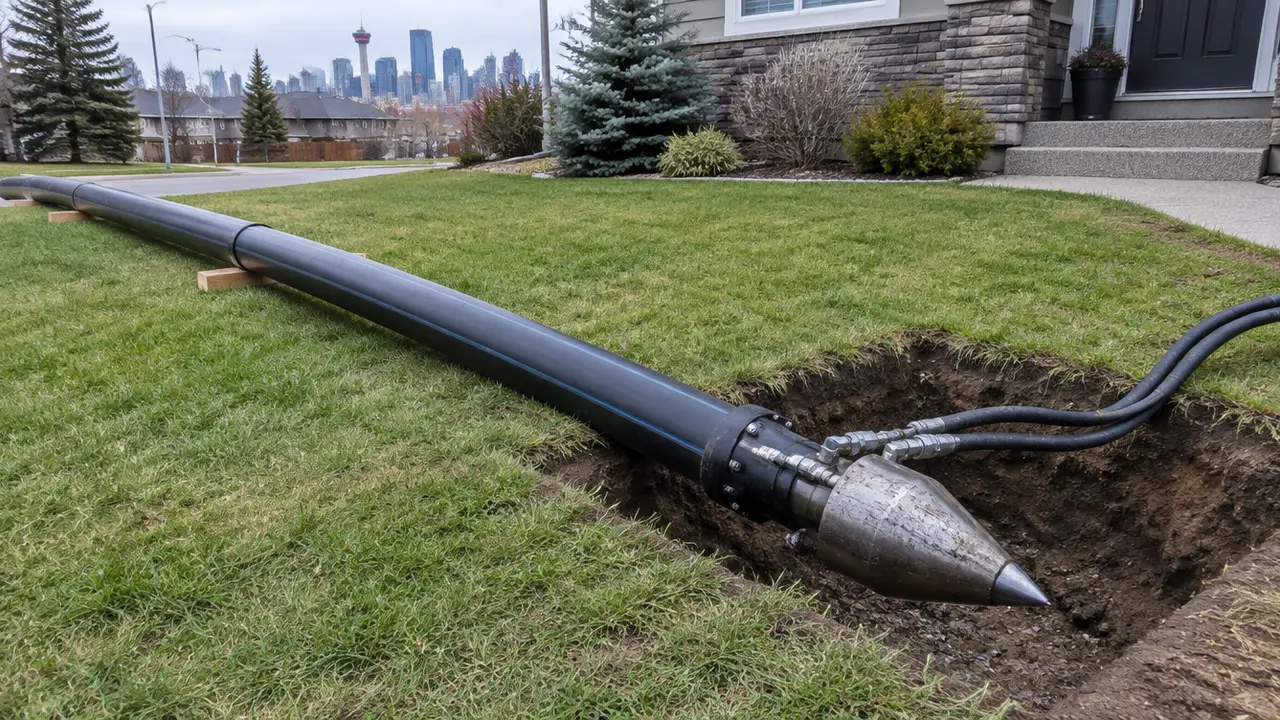
01 /How much does the ground move during pipe bursting?
Every burst moves ground, because the expander is always larger than the old pipe. The EPA's 2006 fact sheet describes the outward displacements as localized and dissipating rapidly away from the bursting operation, while noting they can still cause heave or settlement above the pipe or at some distance from it. It names three critical conditions: a shallow pipe, where displacement is directed upward; much larger replacement pipe; and deteriorated utilities within two to three diameters of the pipe being replaced.
The PPI Handbook of Polyethylene Pipe describes the same effect as a compressed plastic zone around the new pipe surrounded by an elastic zone, with their size tied to the amount of upsizing, the pipe diameter and the soil. Compressible soils keep the movement close to the pipe. Dense soils, backfill below the water table, and expansive or collapsible soils spread it further or complicate it.
You can see the scale of displacement for your own sizes in the Upsizing & Displacement Calculator. It is geometry only and does not predict heave, but it shows why a small host with a large new pipe deserves more caution.
02 /How close can bursting get to gas, water and power lines?
Closer than most people expect, if the utility is in reasonable condition and its position is known. The PPI handbook reports that utilities in moderate condition are unlikely to be damaged by vibration beyond about 2.5 ft (0.8 m) from the head in typical pneumatic bursting of pipes under 12 inches, and about 7 ft (2.1 m) for large-diameter bursting up to 24 inches. It cites separate work finding ground displacement unlikely to cause problems beyond two to three diameters from the pipe alignment. Utilities closer than those distances should be exposed before bursting.
| Situation | Reported distance | Context |
|---|---|---|
| Buried utility, small pneumatic bursting (<12 in) | About 2.5 ft (0.8 m) | Utilities in moderate condition, vibration |
| Buried utility, large bursting (up to 24 in) | About 7 ft (2.1 m) | Vibration |
| Any buried utility, displacement | 2 to 3 pipe diameters | Ground movement |
| Sound residential building, small bursting in soft soil | 8 ft (2.4 m) | Vibration safe distance |
| Sound commercial building, small bursting in soft soil | 4 ft (1.2 m) | Vibration safe distance |
| Sound residential building, large bursting in rock | 11 ft (3.4 m) | Vibration safe distance |
Those numbers come from specific test programs and assume structurally sound buildings and located utilities. They are a sense of scale, not a rule for your yard. The Pipe Bursting Fit Check uses a simpler editorial screen: +1 when utilities have not been located yet, and +2 when something is within about half a metre, because at that distance it may need to be exposed and protected.
03 /Can pipe bursting damage a house, driveway or lawn?
It can, mostly through heave over shallow pipe and vibration close to structures. The EPA fact sheet lists ground heave with shallow pipes, and significant ground movement from the percussive action of dynamic heads, among bursting's disadvantages, and notes that typical pneumatic bursting can create quite noticeable surface vibration. The PPI handbook adds that shallow bursting can damage pavement and that saw-cutting pavement before bursting might be advisable.
- Before work: photos or video of foundation walls, slabs, walks and the driveway, especially existing cracks.
- Near structures: static rather than pneumatic, smaller upsize, or an open-cut section where the line passes under a slab or right beside a footing.
- Shallow runs: consider size-for-size, or dig the shallowest part rather than bursting it.
- Monitoring: on larger jobs, the PPI handbook recommends surveying settlement points on nearby buildings before, during and after bursting.
A pre-work survey and a clear agreement about who repairs what are cheaper than an argument afterward.
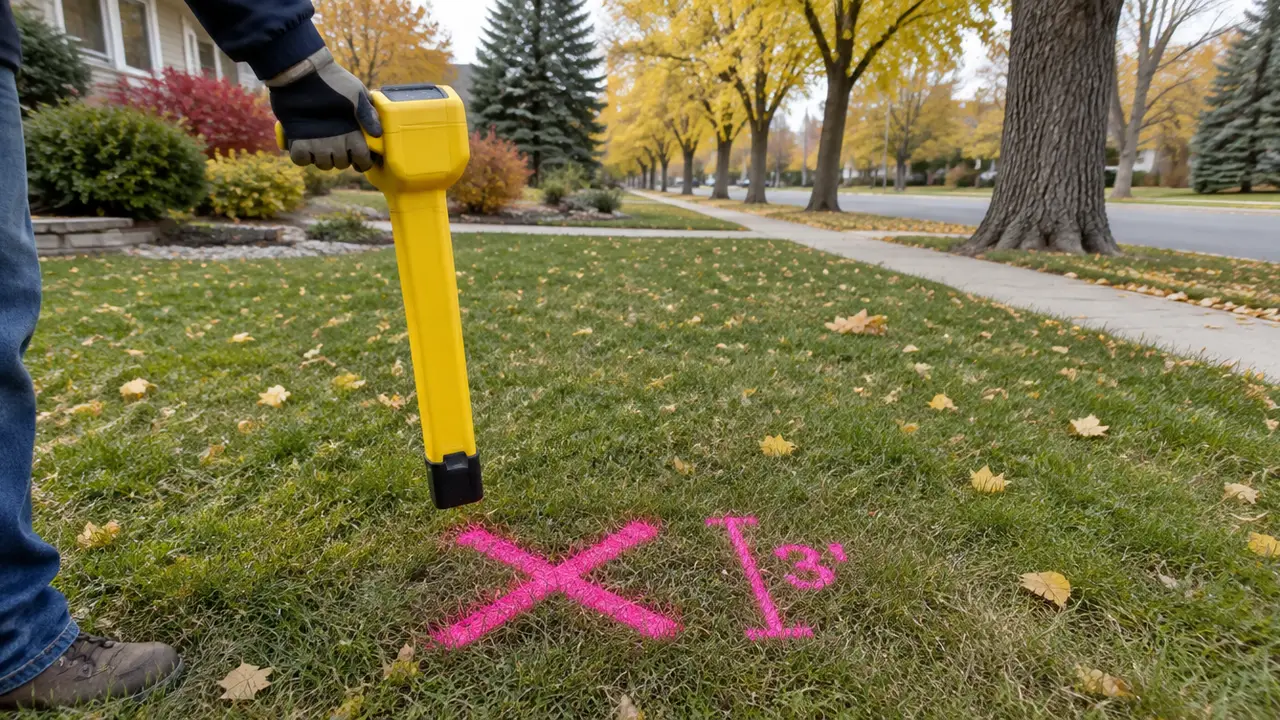
04 /Why do bursting heads get stuck?
Heads stall when the resistance ahead of them or the friction along the new pipe exceeds what the system can deliver. The EPA lists obstructions along the pipe, metallic point repairs, adjacent pipes that prevent the head from deviating, and soil below the groundwater table as conditions unfavourable to bursting. The PPI handbook's risk list adds sharp curves, concrete encasement, excessive run length, collapsed pipe and rock beneath the pipe.
| Cause | How to catch it early | Recovery |
|---|---|---|
| Steel repair clamp or ductile coupling | Camera shows a band or change of material | Dig to it and cut it out |
| Concrete encasement | Camera may show a change in the pipe; old permits or neighbours may know | Expose and break out |
| Collapse the cable cannot pass | Camera stops at that distance | Pit at the collapse |
| Rock, cobble or dense till | Soil knowledge, test pits, local experience | More force, lubrication, shorter runs, or another method |
| Run too long for the friction | Friction estimate before the pull | Intermediate pit, bentonite or polymer lubrication |
| Sharp bend | Camera shows the angle | Bend pit |
The PPI handbook stresses matching the bursting system to the run with a reasonable margin for unforeseen sleeves and clamps, and lubricating the new pipe to reduce friction. A stuck head is usually recovered by digging down to it, which becomes an unplanned pit.
05 /What other problems show up during or after a burst?
- Groundwater. Bursting in saturated soil can raise water pressure around the head, and the EPA notes groundwater may flow toward open pits. Dewatering can then undermine nearby structures if fines are drawn out.
- Fragments in a manhole. The EPA mentions pipe fragments occasionally being pushed into the receiving manhole, or the manhole being shifted out of alignment.
- Pipe pull-back. Stretched polyethylene can retract after the pull, opening gaps at connections if it is tied in too soon.
- Damaged laterals. The PPI handbook lists damage to laterals from bursting of the main line as a risk; services should be disconnected before the pull.
- Settling pits. Pit backfill compacted differently from the surrounding soil can settle, especially after the first winter.
- Inherited grade. A sag in the old line is likely to be reproduced; see sags and grade.
06 /What are the real pros and cons of pipe bursting?
A contractor's contingency plan should cover, at minimum, excessive ground movement or vibration, slow progress or a stuck head, trouble with bypass or reconnecting services, damage to an existing utility, and dewatering problems at a pit. The PPI handbook lists exactly those events. Ask to see how each is handled and priced before you sign, then compare installers with the contractor survey checklist. If you want independent eyes on a plan, send it to the desk.
FAQQuestions people ask
Can pipe bursting cause my driveway to crack?
It can if the line is shallow under the slab or the upsize is large, because displaced soil moves upward. Installers reduce the upsize, use static equipment, saw-cut or dig that section.
How close to a gas line can a bursting head pass?
Research summarized by the PPI suggests small bursts rarely harm utilities beyond about 0.8 m, but any gas line near the route should be located and exposed before the pull.
What happens if the bursting head gets stuck halfway?
The crew usually digs down to the head, clears whatever stopped it, and either continues from that pit or re-plans the run. The contract should price that event.
Does bursting work below the water table?
It can, but the EPA and PPI both describe it as harder: water flows toward pits, pressures rise around the head, and dewatering may be needed.
Can bursting my sewer damage the neighbour's line?
If the neighbour's service runs close to or connects near yours, yes. It should be located, and if close, exposed and protected before the pull.
Is pipe bursting noisy for neighbours?
The excavator, compressor or power pack make the most noise. Pneumatic heads also transmit a thumping vibration through the ground while the head is moving.
NETWORKGo deeper across the HAUSE Sewer network
Sewer line locating and depth: how the mark on your lawn is made
How sewer line locating and depth readings work: the sonde, the hand-held locator, peak and null readings, marking, accuracy, and calling before you dig.
PipeCleaning.caDIY vs professional pipe cleaning: where to draw the line
DIY vs professional pipe cleaning: which drain jobs homeowners can do safely, which tools to skip, the injury risks, and when a pro is cheaper.
DrainAugering.caAuger Cable Sizer: pick the cable, head and machine before you start
Auger Cable Sizer: choose the line, the distance to the clog and the clog type to get drum or sectional cable, length, head, machine class and a pro flag.