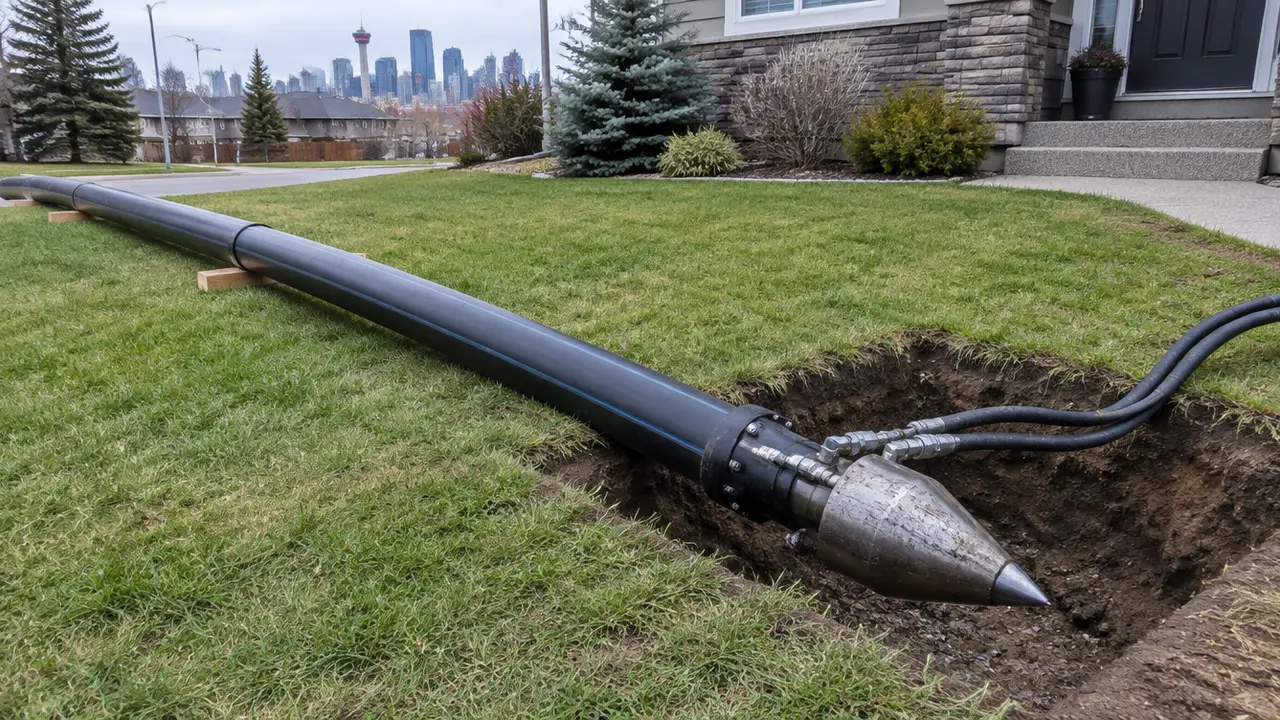
Every bursting run needs a launch pit where the new pipe enters and a receiving pit where the puller or winch sits. More pits are added at each branch connection, at bends the head cannot follow, and at known obstructions. The launch pit must be long enough for the new pipe to curve down gently, and there must be room behind it to lay out and fuse the pipe string.
- Pit count, not metres of pipe, is usually what makes one bursting job cost more or disrupt more than another.
- The launch pit has a flat section to line up the head and a sloped section sized to the new pipe's bend radius.
- The receiving pit houses the puller and a thrust surface strong enough to take the full pulling force.
- Space to lay out the fused pipe string limits how long a single pull can be.
- Pits are excavations: trenches 1.2 m or deeper need a protective system unless cut entirely in stable rock.
01 /How many pits does a pipe bursting job need?
The minimum is two per run: one to launch and one to receive. Everything else is driven by what is along the line. The EPA's 2006 fact sheet lists insertion pits as a disadvantage of bursting compared with lining, unless a manhole-to-manhole system is used, and its implementation steps include disconnecting services and removing impediments, both of which usually mean excavations.
| Pit type | Reason | Typical location on a house lateral |
|---|---|---|
| Launch (insertion) pit | New pipe and head enter the host pipe | Near the foundation, or near the property line if pulling toward the house |
| Receiving (pulling) pit | Puller or winch, thrust plate, head recovery | At the opposite end of the run |
| Service or branch pit | Disconnect a branch before the pull and remake it after | Garage drain, suite connection, second building |
| Bend pit | Change of direction sharper than the head can follow | Where the line turns around a tree, deck or corner |
| Obstruction pit | Repair clamp, encasement or collapse found on camera | Wherever the camera found it |
| Split-run pit | Run too long or too high-friction for one pull | Midway; one pit can launch in two directions |
The PPI handbook recommends placing pits where excavation is needed anyway, at manholes, valves, lateral connections and fittings, and using one insertion pit to launch in two directions where possible to cut total digging.
02 /How big is a launch pit, and why?
A launch pit has two parts. A flat section at pipe depth lets the crew line up the head with the centreline of the old pipe. A sloped section lets the new pipe curve from the surface down to that depth without being bent tighter than it can take. The PPI handbook says PE can be cold bent to roughly 25 to 30 times its outside diameter, which is the number that sets the slope length.
The handbook gives a worked example for a large main: for 18-inch DR 17 pipe, a minimum insertion shaft length of 12 times the new pipe diameter for the flat part plus 2.5 times the shaft depth for the sloped part. Residential pits are much smaller, but the logic is the same: deeper pipe and larger pipe both mean longer launch pits.
- The pit is usually trimmed so the crown of the old pipe is removed to its spring line, giving the head a clean start.
- Its width depends on pipe size and room for workers to connect the head safely.
- Where the fused string cannot be laid in line with the pipe, the flexibility of HDPE lets it come in at an angle, within its bend radius.
On a house lot the launch pit is often the biggest hole of the job, and where it goes is a real decision. Launching beside the foundation keeps the long sloped entry in the back yard but puts the heaviest digging near the footing and any gas meter. Launching at the property line and pulling toward the house moves that slope to the front yard or boulevard and puts the compact receiving pit by the wall. Ask the installer why they chose one direction.
03 /What goes into the receiving pit?
The receiving pit holds the pulling unit and must survive the force it applies. The PPI handbook explains that the winch or puller thrusts against the manhole wall or one side of the pit, so a thrust block or plate is needed to spread that force, and the soil behind it must resist the load with a margin of safety.
- Room to work. The puller, rods or cable drum, and space to separate the head from the new pipe when it arrives.
- A strong back wall. Undisturbed soil or a built thrust structure; a pit dug in loose fill may need more support.
- Dewatering. The handbook calls for dry pits; a sump in one corner handles rain or a slightly high water table.
- Inspection space. The head end of the new pipe is examined here for gouges after the pull.
04 /How much yard space does the pipe lay-down need?
A continuous fused string needs a clear strip roughly as long as the run behind the launch pit, or a curving path the pipe can follow within its bend radius. The EPA names the area available for pipe lay-down as one of the factors that limits how long a run can be, because it caps the length of pipe that can be fused and laid out.
| Constraint | Common workaround | Trade-off |
|---|---|---|
| Short yard, long run | Fuse in stages and join at the pit | Pull pauses while each new length is fused |
| String would block a lane or sidewalk | Lay the string along the lot and curve it in | Needs enough radius and a longer sloped entry |
| No room at all | Launch from the other end, or use short segmented pipe | Segmented pipe adds joints |
| Neighbour's property needed | Written permission before layout | A detail to settle in the contract |
Ask to see the lay-down path on the site sketch. It tells you which parts of the lawn, driveway or lane will be occupied, and for how long.
05 /What safety and locate rules apply to bursting pits?
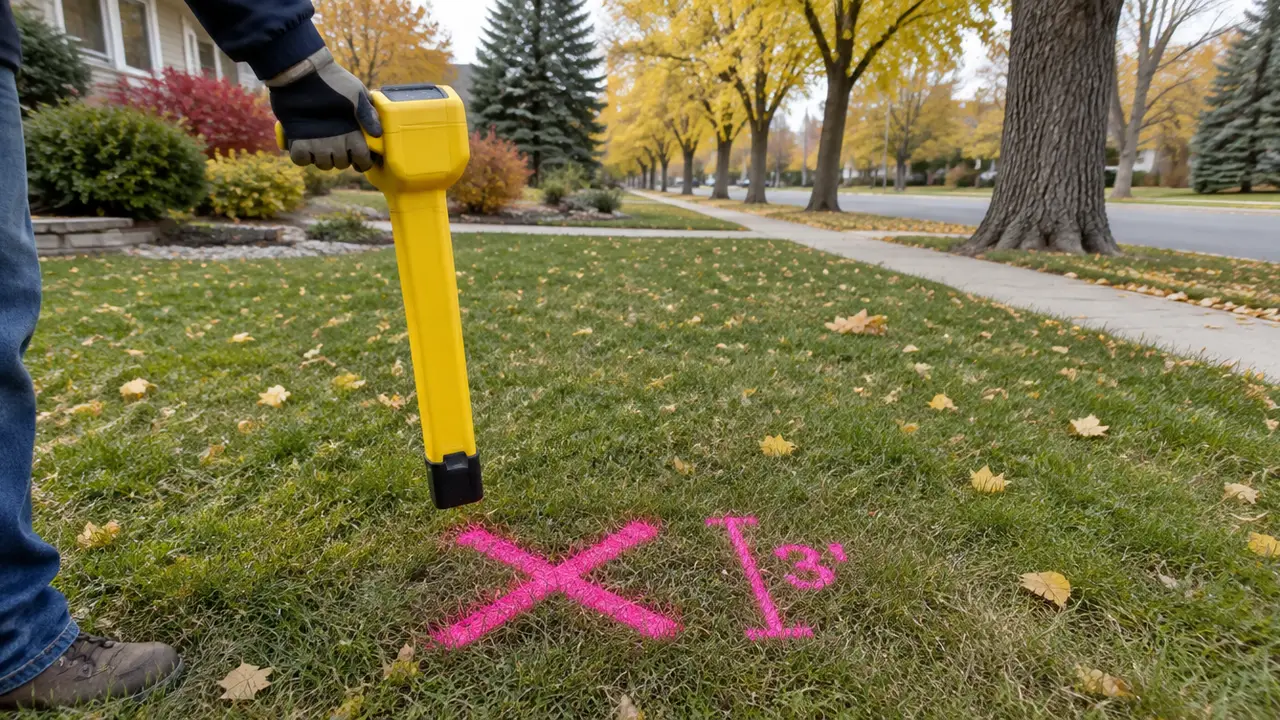
Bursting pits are excavations like any other. The Canadian Centre for Occupational Health and Safety says trenches 1.2 m (4 ft) deep or greater require a protective system unless the excavation is made entirely in stable rock, and that pipe, spoil, tools and other materials should be kept at least 1 m from the edge. Provincial occupational health and safety rules set the legal requirements for the crew; confirm the specifics in your province.
Before anyone digs, buried utilities must be located. In Alberta, Utility Safety Partners runs the one-call service; its locate page says a minimum of three full working days' notice is required for a routine request and five for large project tickets, and that you are not clear to excavate until all utilities have been located. Other provinces have their own services, listed through ClickBeforeYouDig. One-call marks utility-owned lines; private lines such as a garage feed or gas line to a barbecue may need a private locator.
06 /What should a pit plan on a bursting quote show?
A quote you can hold an installer to includes a simple drawing. The PPI handbook's submittal list for public projects includes site layout, pit locations and dimensions, shoring design, bypass plan, pipe storage and restoration; a residential version can be one page.
- The route of the old pipe, with depth at each end if known.
- Every pit, numbered, with its purpose and the surface it breaks: lawn, concrete, pavers, asphalt.
- Where the fused pipe will be laid out and for how long.
- Located utilities near each pit and near the route.
- What happens, and at what price, if an unplanned pit is needed.
- How each pit is backfilled, compacted and restored, and when.
Pit count drives price. The pipe bursting cost page shows each pit as its own planning line. The Fit Check adds a point for three or more connections because each needs a pit, and the sewer lateral guide shows where pits usually land on a house lot. When you have a layout in mind, request quotes and ask each installer to sketch theirs.
FAQQuestions people ask
How deep are pipe bursting pits?
As deep as the pipe, plus working room below it. A lateral protected from frost in a cold climate is often a couple of metres down, and deeper runs need shored pits.
Can an existing cleanout be used instead of a pit?
A cleanout helps with camera access and cable threading, but a head and new pipe need a real excavation to enter and exit.
Can bursting be done from manhole to manhole with no pits?
On municipal mains, some systems work from existing manholes, as the EPA fact sheet describes. House laterals almost always need pits.
How long are bursting pits left open?
Usually from the day they are dug until the new pipe is connected, tested and inspected, often one to a few days on a lateral. Ask how they will be secured overnight.
Who restores the lawn or driveway over the pits?
That depends on the contract. Some quotes include only rough backfill; others include sod, concrete or pavers. Get it in writing.
NETWORKGo deeper across the HAUSE Sewer network
Pipe bursting cost: trenchless sewer line replacement, priced
Pipe bursting cost in Canada (2026): trenchless sewer replacement ranges in CAD, pit and per-metre pricing, upsizing, and when it beats lining or digging.
SewerJetting.caSewer jetter nozzles explained: which head does what
Sewer jetter nozzles explained: penetrator, flushing, rotating, root cutting and descaling heads, jet angles, and which suits grease, roots or scale.
DrainAugering.caWhat drain augering is, and how a spinning cable clears a clog
Drain augering explained: how a rotating steel cable reaches, bores through and retrieves a clog, what it clears well, and where augering stops working.
SOURCESSources and further reading
- Canadian Centre for Occupational Health and Safety — Trenching and Excavation
- Utility Safety Partners — Submit a locate request (Alberta)
- ClickBeforeYouDig — one-call services by province
- US EPA — Water Technology Fact Sheet: Pipe Bursting (EPA 832-F-06-030, 2006)
- Plastics Pipe Institute — Handbook of Polyethylene Pipe